 En
 Fr
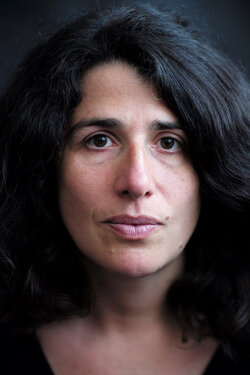

Patric Chiha and I went to see a sublime black-and-white film by Kira Mouratova, Brief Encounters, from 1967, and he gave me a book that was extremely important to me : The End of the Red Man, by Svetlana Alexievich. Thanks to him, I discovered an author, a tone and a feeling.
That strange feeling of a time of lost happiness ; already gone or unattainable. You could call it melancholy or nostalgia for a time or place that we idealise ; it could be childhood, communism, "being together"...
As a teenager, I was high on Russian literature : Tolstoy, Dostoevsky, Pushkin.
Later, at 25, I even had the chance to spend a month at VGIK with Vadimr Yussov, who shot Tarkovsky’s Andrei Rublev, my favourite film.
He pushed for simplicity. And I think it takes a long time to know what it means to "be simple". Today I understand it much better than I did in those times.
I have very fond memories of that month spent in Moscow and the evenings spent chatting, playing guitar, and singing together in an unknown language. An unknown language, but one in which melancholy regularly reared its head, a form of heartbreak that was already familiar to me thanks to literature.
My grandmother listened to Vladimir Vysotsky, whose songs are a mixture of sweetness and pain. They permeated my childhood, as did the question of exile and uprooting.
Reading Svetlana Alexievich and The End of the Red Man, I understood another family melancholy, that of the communist era, of an ideal never achieved, of a utopia never experienced.
Why I am telling you all this ? Just because this film is deeply rooted with these questions, these contradictions, these doubts.
A Russian Winter is the story of the exile of young people lost around the world (Istanbul, Paris) who are trying to put a name to what is happening to them.
As a matter of fact, his previous movie, The Beast in the Jungle (2023), was already a bit like that : two people trying to fill a void ; an uncertainty, a doubt even before experiencing it, and who talk about it as a possibility. Two characters like exiles from themselves.
Here, they are experiencing it because the war in Ukraine is driving them away from their country and into voluntary exile. They are trying to fill this void, to live this exile.
What does it mean to flee ? What does it mean to resist ? What does it mean to lose your bearings, your anchors ? What does it mean to feel powerless in the face of the world ?
Patric had talked to me a lot about the indifference of the world, its harshness ; about sterile places that are the same in Paris or Istanbul or Russia ;"non-places", you might say.
The idea behind all the Parisian settings is that we could have been anywhere in the world... We filmed at La Plaine Saint-Denis and Rosa Parks in the 19th arrondissement, Martin Luther King Park in the 17th arrondissement and at Le Fresnoy studio. The studio was also possible as a place of abstraction in the same way as the nightclub in The Beast in the Jungle. At first, Patric wanted to insert "non-places" (steel sheets) behind the characters, but in the end, the green remained green and the studio an empty place with a sofa and light. He also wanted an acid image ; unpleasant. Sweet-bitter, but above all bitter. Digital, aggressive.

Technically
We didn’t really choose our cameras, except for the last one, for economic reasons. The first was a RED Epic, loaned by Le Fresnoy (co-producer of the film), the second a Sony Burano loaned by Sony (Jean-Yves Martin, whom I warmly thank), and the last was the digital Bolex that Laurent Ripoll (colourist) and Martin Roux (director of photography) had been telling me about for a long time. It’s actually a 2K camera with a very "reversal stock" aspect. I really enjoyed working on this image, especially during colour grading with Alexandra Poquet.
There was an element of acceptance of chance in this shoot ; a form of randomness that made us free to take in whatever might happen. The opposite of control or rigidity.
It was joyful and bitter. We didn’t understand the language, but we understood the tone and what was going on emotionally.
Thank you to the producers Katia Khazak and Charlotte Vincent for taking risks by producing this kind of film in a paralysed world that is taking fewer and fewer risks.
Thank you to Mathias Sabourdin, assistant camera, who accompanied me on the Parisian winter part, and Arnaud Gaudelle on the spring part. And Guillaume Delsert, who helped me with the lighting at Le Fresnoy.
After the invasion of Ukraine in 2022, many Russians were faced with a painful choice : prison, the army—or exile. Margarita, Yuri, and their friends were forced into exile because they refused to bow to the regime. Tossed about by history, welcome nowhere, they search for their place in the world.


